


short course
Bartonella Support
Infection Support
Maintenance & Recovery
Persister Cell Support
A concentrated root tincture of Cryptolepis sanguinolenta, a traditional West African botanical, supporting immune health and healthy microbial balance for growing and persister states.



10% off all supplements
Use code at checkout
MARTYROSS10


Opens Femologist.com in a new tab
TreatLyme and Dr. Marty Ross, MD, are affiliated with Femologist. We may earn a commission on purchases made through this link or code.
Quick Facts
Key Ingredients
Cryptolepis (Cryptolepis sanguinolenta) 554 mg
Third-party Testing
Dietary

Written by

Dr. Marty Ross, MD
Updated
September 24, 2026
Dr. Ross's Expert Review
Every herbal immune-support regimen I build starts with a short list of workhorse herbs. Cryptolepis sanguinolenta is on that list. It is a West African botanical with a long history in traditional medicine, and it has earned its place in modern herbal protocols.
The Montana Farmacy version is a concentrated 1:5 root tincture, nothing but the extract, organic cane alcohol, and water. I like single-herb tinctures for one practical reason: dosing is clean. When a regimen has five moving parts, I want to adjust one herb at a time without guessing which capsule did what.
What the research shows
Laboratory work on this herb is better than most. In test-tube studies, Cryptolepis extracts showed strong inhibitory activity against Babesia duncani, with no regrowth after subculture, and good activity against Borrelia burgdorferi. Other studies show activity against growing and persister states of Borrelia and Bartonella in the lab. Cryptolepine, its main alkaloid, showed antiprotozoal activity against several Babesia species in lab and animal work. There are no large human trials of this herb.
What I watch for
Die-off type reactions are the main issue when starting. Some people report feeling worse before they feel better early on, so the answer is a low start and a slow climb. Toxicology work suggests the herb is generally well tolerated at typical doses, though safety in pregnancy has not been established, which is why it is avoided there.
The bottom line
This is one of the few herbs where the lab science, traditional use, and my clinical observation all point the same direction. That combination does not come along every day. Work with your physician on dose and on where it fits in a full plan.
These statements have not been evaluated by the Food and Drug Administration. This product is not intended to diagnose, treat, cure, or prevent any disease. Dr. Ross has a financial relationship with the Femologist store, where this product is sold.
How I Use It in My Practice
I use Cryptolepis most in ongoing herbal immune-support regimens, usually for months at a stretch rather than short bursts. The dose depends on the situation and is always set with the person’s physician. My usual range works up from 2.5 ml three times a day to 5 ml three times a day when more ongoing support is the goal. I never start at the target dose. I begin with a fraction, once a day, and increase every few days as tolerated. If die-off type symptoms show up, fatigue, body pain, or brain fog, that means the climb was too fast, and I hold or drop back. The tincture can be diluted in water or juice, which helps with taste and stomach comfort.
This reflects Dr. Ross's clinical experience and is educational, not medical advice. Work with your treating physician before starting, stopping, or changing any supplement or medication.
The Research, in Dr. Ross's Words
In my review of research, Cryptolepis sanguinolenta has a better laboratory record than most herbs used in tick-borne infection support. Zhang and colleagues screened 46 herbal medicines against Babesia duncani and found Cryptolepis among the standouts, with the ethanol extract showing no regrowth after six days of subculture at several multiples of the inhibitory dose. The same paper reported good activity against Borrelia burgdorferi. Additional laboratory research shows Crypto is effective against growing and persister states of Bartonella and Borrelia.
Cryptolepine, the plant’s main alkaloid, carries the story further. Batiha and colleagues showed growth inhibition against several Babesia species in vitro and against Babesia microti in mice, including some activity alongside standard babesiocidal drugs. Shor and Schweig reviewed the broader nutraceutical literature and pointed to Cryptolepis as a leading option among persistent tick-borne infection herbs.
Nearly all of this work is in vitro or in animal models, with no controlled human trials. The papers also note safety questions, including possible anti-fertility and embryotoxic effects, which is why the herb is avoided in pregnancy. Clinically I see benefits in my practice supported by the laboratory research findings.
References
From:
Montana Farmacy
Discover the powerful Cryptolepis Liquid Herbal Tincture (4oz). This tincture is a standout choice among natural health supplements, known for its potent support in promoting immune health.
Directions of Use
Take 1 dropper 1-3 times a day.
Does not contain
Avoid during pregnancy.
Excerpted from Montana Farmacy's product information. These statements have not been evaluated by the Food and Drug Administration.
Supplement Facts
Serving Size: 0.7 ml
Servings Per Container: about 168
| Amount Per Serving | Amount | |
|---|---|---|
Cryptolepis (Cryptolepis sanguinolenta) | 554 mg | |
‡ Daily Value (DV) Not established | ||

Common Questions about Cryptolepis
Answers are general educational information, not medical advice for your situation.
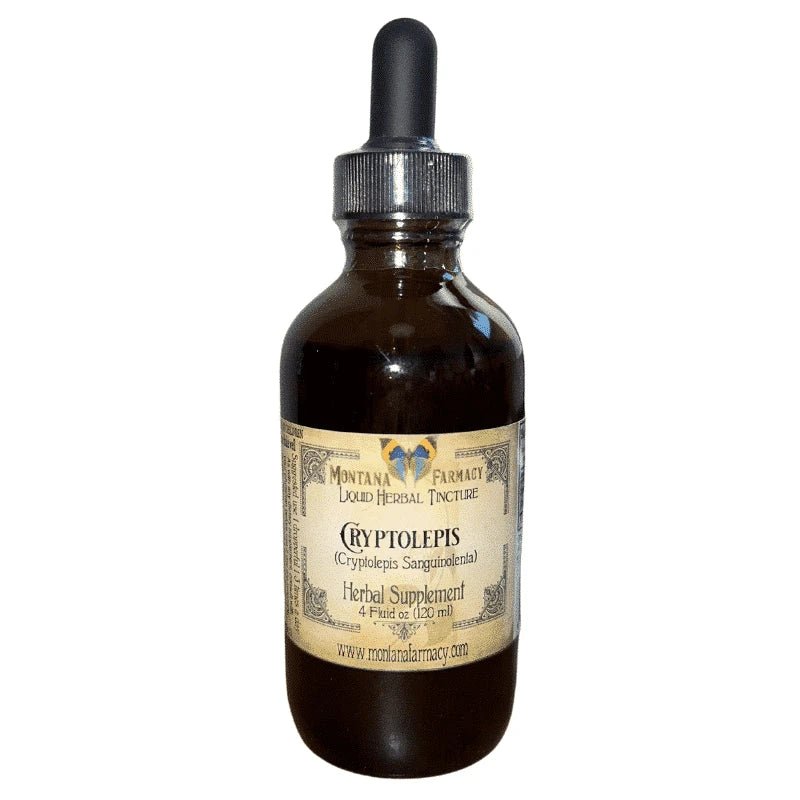
Cryptolepis
By Montana Farmacy
From $50.00 · Save 10% with code MARTYROSS10
Crypto-Sida-Alchornea
A combination tincture that pairs Cryptolepis with Sida Acuta and Alchornea.




Guide
Best Herbal Antibiotic Plans for Lyme, Bartonella, and Babesia
Dr. Ross's herbal antibiotic plans, where Cryptolepis is a core herb.

Guide
The Ultimate Bartonella Management Guide
Bartonella guide that covers Cryptolepis dosing in combination regimens.
Guide
Kills Babesia: A Brief Guide
Babesia guide covering herbal options that include Cryptolepis.